Social Business for the Boardroom

Training for Emerging Trends

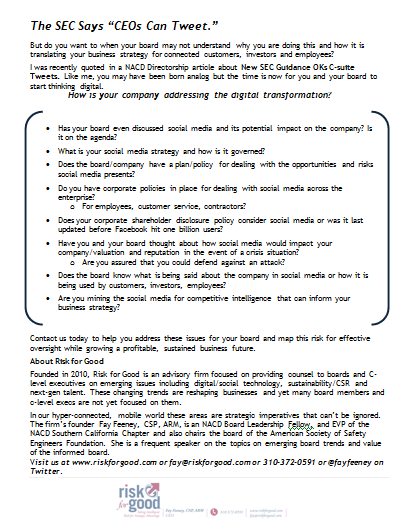
Risk for Good has a keen interest to insure that board members are using all the technology and perspectives available to them to manage risk.  Our process is to help your board manage risk so it can grow and mature on plan.

We believe that Board Directors set the culture for risk taking in the boardroom, and for the CEO.  To grow successfully, you need to understand that risk is good. Hence our name, Risk for Good.  We teach you how to use risk as a tool, not a threat.

Risk intelligence refers to an individual’s or an organization’s ability to weigh risk effectively.

It involves classifying, characterizing, and calculating threats; perceiving relationships; learning quickly; storing, retrieving, and acting upon relevant information; communicating effectively; and adjusting to new circumstances.

The Risk for Good – Five (5) Step “REACH Process ” is the framework for ensuring good governance over social media governance.  We work with the board members to help them gain an understanding over their board’s risk challenges and opportunities.

Report of the NACD Blue Ribbon Commission on Risk Governance: Balancing Risk andReward (Step 2: Risk Evaluation & Identification)

Risk for Good - ”REACH Process” Elements:

1) Risk Communication – Listening In to risks & opportunities

2) Evaluation and Risk Identification

3) Assess Risk

4) Choosing your Options: Managing/Mitigating/Optimizing Risk

5) How to optimize your plan

Risk for Good – Board Chair: REACH Process Elements:

Step 1: Risk Communication – Listening In

You want information flow that is relevant, accurate, and timely.  This is a key to real business intelligence.

This is where Risk for Good begins: we help you map out the relevant sources to tap for important factors.  We construct a “tailor made” road map to “listen in” on customers, investors, employees, competitors and more.  We gain information to identify emerging issues before they become a threat and impact your company.

2. Evaluation and Risk Identification

Every company must deal with uncertainty.  Generally, management should identify and list the specific material risks the company faces, indicate the likelihood that they will actually occur, and estimate their potential cost versus the cost of prevention.  However, management cannot conceive of every possible risk.

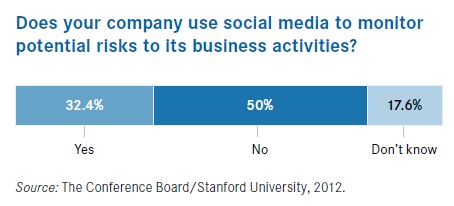
By monitoring the social media conversation boardrooms have an opportunity to identify what is being said about their brand, their competitors, and their markets.  It is unforeseen risks—not the predictable ones—that have the potential to cause the most problems for a company.

3. Assess Risk

Assessing risk from the social conversation is an on-going process.  Once you listen in to what is being said next step is for the director to ask management, “Who is the owner of each risk area?”

4. Choosing your Options: Managing/Mitigating/Optimizing Risk

The ultimate goal of a risk program is to help management incorporate risk intelligence into strategy.  This concept is important to ensure the board views risk-taking for reward and growth.

For a crisis situation, risk mitigation is necessary to protect existing assets.  This is assisted by strong corporate culture, reputation, and credibility.

The board should proactively encourage a “Tone at the Top, Middle and Bottom” that conveys basic values of ethical integrity, legal compliance, and strong financial controls to all levels of the organization.

5. How to Optimize the Plan

The board is responsible for ensuring that a sound plan is in place to monitor the social conversation in the boardroom and throughout the organization.  These are evolving risks that your board will manage on a continuing basis by integrating them into your business strategy.

________________________________________________________

*SOURCE: Risk Intelligence: Learning to Manage What We Don’t Know

David Apgar © 2006, Harvard Business School Press